zurück |
The Diary of Hebel's Swiss Journey in 1805 |
 |
|||
|
Feuilleton section of the Neue Zürcher Zeitung, June 23–27, 1900
Editor’s Note. We are pleased to present below a previously unpublished
diary by Hebel, which the Alemannic poet kept during the trip to
Switzerland he undertook in August and September 1805 as a mentor to
Barons Carl and Ernst von Metzingen. The diary, dedicated to his noble
pupils, is currently housed in the family archive of the Barons of
Metzingen at Metzingen Castle near Bruchsal. Friends of Hebel’s charming
muse will, however, be somewhat disappointed by the account of his Swiss
journey. Like Hebel’s sermons, the account reveals little of the poetic
spirit and mischievous humor of the author of the “Alemannic Poems.” Only
in a few places does his poetic and original nature shine through;
otherwise, the diary is mainly proof that even the finest poet is of
little use once he is cast in the role of a tutor. On the other hand, some
aspects of the travelogue may be of cultural-historical interest to
readers. We limit the reprint of the diary to the section relating to the
journey through Switzerland, omitting, moreover, certain passages that are
mere lists of names. The journey lasted from August 22 to September 22,
1805. It began in Karlsruhe and led via Offenburg, Krummenschiltach,
Villingen, and Donaueschingen to Schaffhausen on August 25, from which
point on we let the poet speak for himself. |
The brilliant special
exhibition: |
||||
|
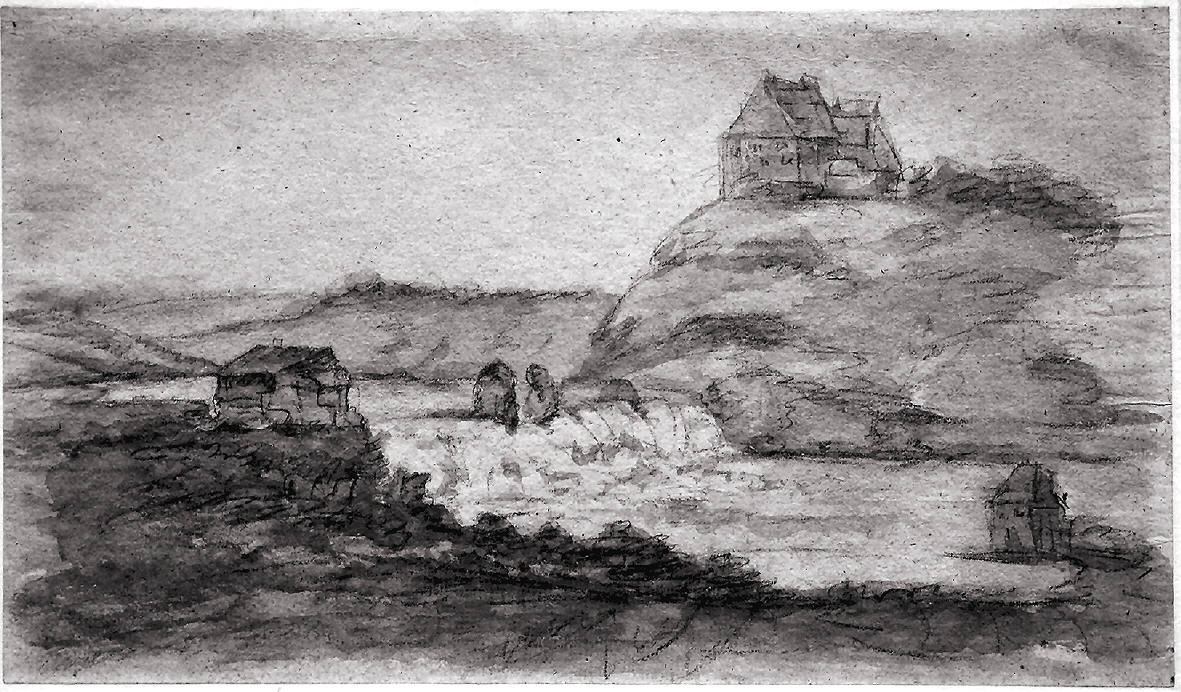
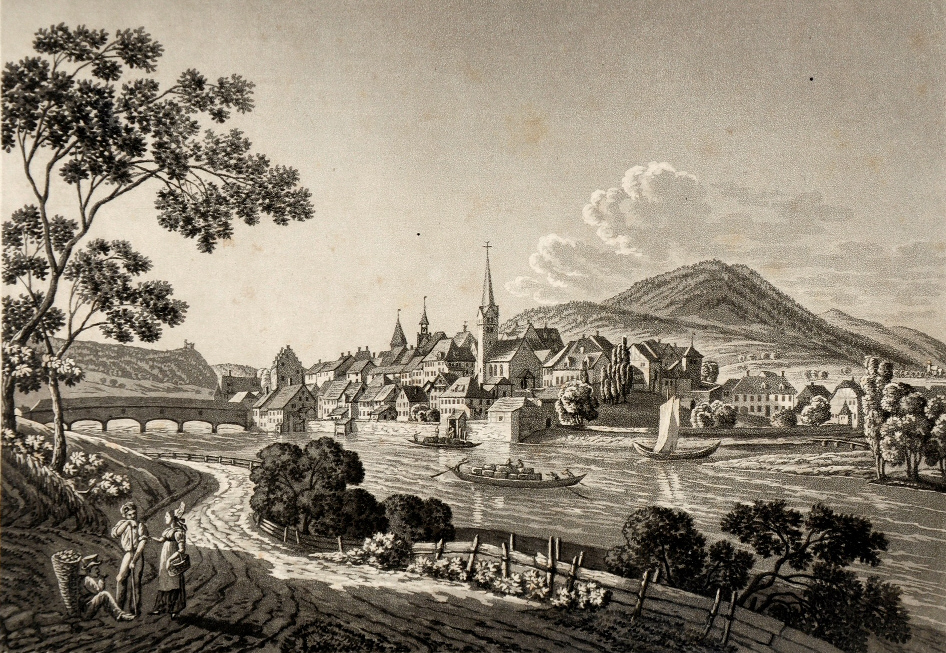
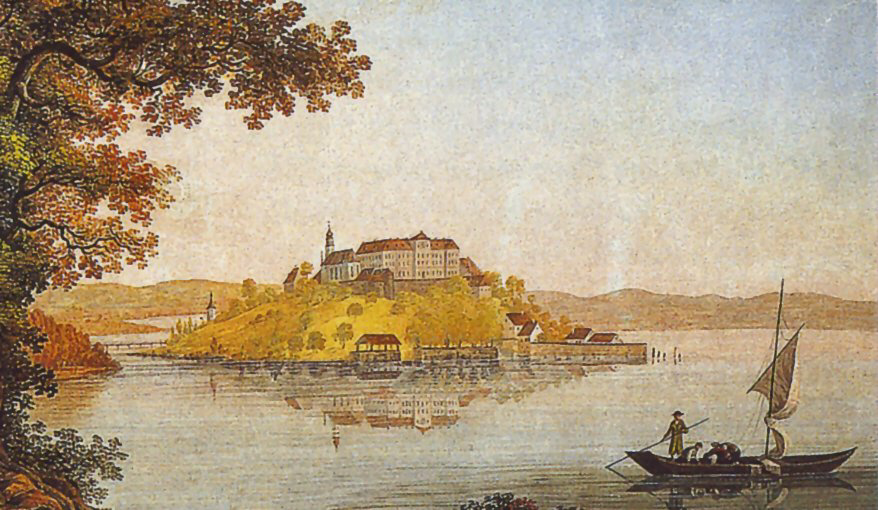
>> 1 At 9 o’clock in the evening we reached Schaffhausen. A nice new hat proclaimed his freedom on Swiss soil, took to his heels that very evening, and was never seen again. Schaffhausen is the capital of a Swiss canton of the same name, located on this side of the Rhine and of the Reformed faith, surrounded by mountains quite close by. This morning we viewed the most interesting part of the town and, on a nearby hill, the old fortress of Unnoth. It consists of a large, walled round tower and a high tower. From this one can overlook the entire town and surrounding area. Inside, the sturdy, spacious vaults and the beautiful paved path leading down to the deep foundation are worth seeing. The cornerstone is said to have been laid in 1516. Rare modesty on the part of a tower keeper! According to Ebel’s more plausible account, this structure dates back to the ancient Romans. From here we went to the new Rhine bridge. It was first crossed on July 15. The old one, built in 1758 by Grudemann, consisted of a suspension structure supported by a single pillar and was considered a masterpiece of bridge engineering until it was burned down by the French on April 18, 1799. Since then, the situation has been the opposite of what it is with deceased people. While they are alive, there is so much to criticize about them. Once they are gone, the grave covers their faults; one remembers their virtues and mourns their loss. Schaffhausen seemed proud of the old Rhine bridge as long as it stood; now it is said to be full of defects, and people say the new one is better. In the afternoon, we walked an hour past Neuhausen to the Rhine Falls. The entire mass of the river plunges here over and between the rocks—50 feet when the water is low, 80 feet when high—with tremendous force, forming the largest waterfall in Europe. We took our first vantage point at the “Drahtzug.” From here, one looks down above the plunge into the wild turmoil of the waves, which in some places crash fearfully against the rocks, and in others plunge boldly and defiantly downward. Then we crossed the Rhine, passing along the entire front of its fall to the opposite bank. Here, a light yet well-constructed wooden scaffold extends out to the edge of the Rhine Falls, where the cascade is at its most powerful and wild, and the entire view is by far the most interesting. The grandeur and diversity of this scene are indescribable—this wild struggle and storm, this eternal scattering and destruction and renewal, this deafening roar, and then again the fine silver mist of water vapor that swirls all around and is painted with all the colors of the rainbow by the slanting rays of the sun. A steep ascent past Laufen Castle finally leads to a pavilion at the third vantage point, where, from this lofty, almost vertical height, one can gaze down over the Rhine—both above and below the waterfall, and the river itself between the two—while sipping a glass of wine, and admire the view with renewed appreciation. So we did, and on the way back we saw for the first time the high snow-capped mountains, which glistened toward us from a distance of perhaps 20 to 30 hours’ journey in the glow of the evening sun, and arrived back in Schaffhausen on the right bank of the Rhine via the bridge. Monday, the 26th. From Schaffhausen to Constance. 9 hours. It is all the more interesting to descend into the
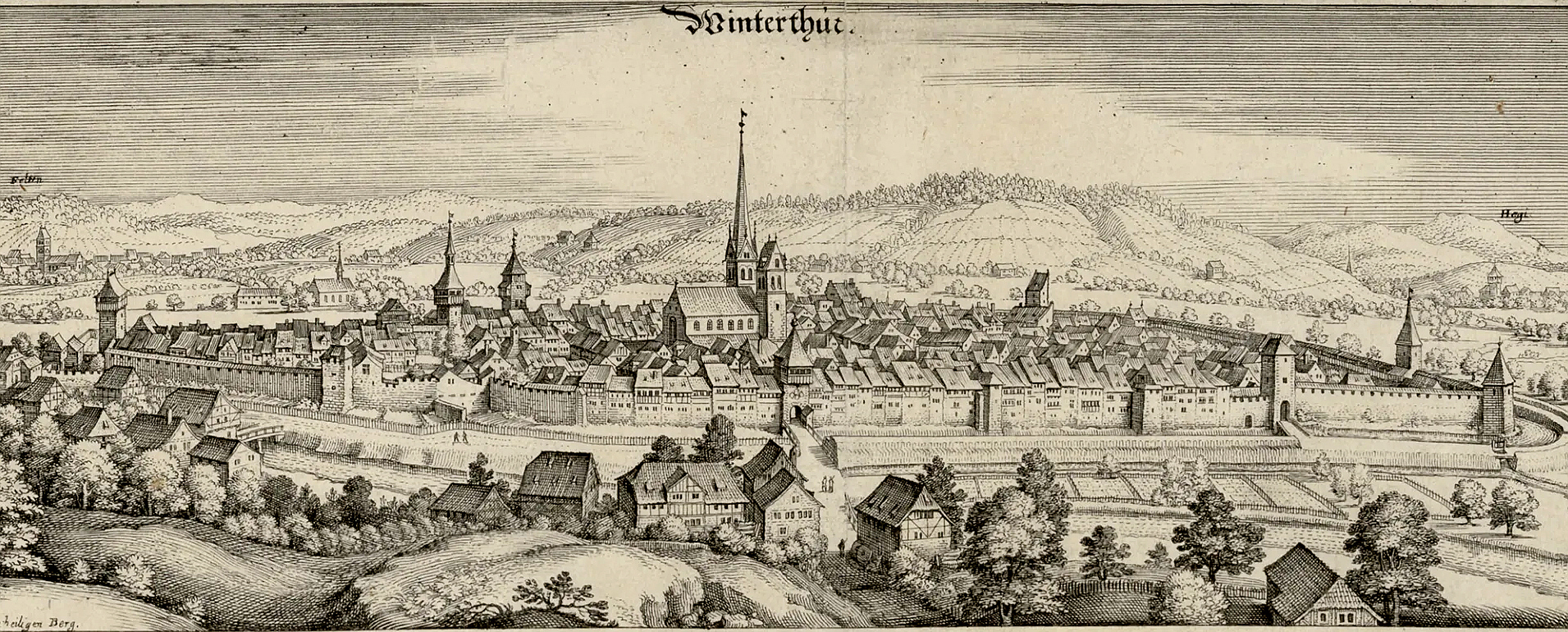
beautiful Thür Valley and visit the city of Winterthur (Canton of Zurich).
A series of beautiful gardens and parks already signals the city’s
prosperity from the outside, and inside, wherever one looks, one discovers
the source of that prosperity: a general bustle of industry and commerce.
From within Winterthur, one crosses the rushing forest stream, the Tös,
and then, leaving the valley behind, travels over new hills toward Zurich,
a journey of little particular interest. |
|
||||
|
>> 2 Thursday, the 29th. Zurich. This city, with a population
of about 12,000, lies in a fairly narrow valley between the Züriberg and
the Albis, at the end of a lake and the Limmat, which flows out of it here;
it is the capital of the first canton and of the Reformed faith. The
location of the Zum Schwerdte inn is extremely interesting. It stands on
the Limmat at the wide bridge, which also serves as the market square.
Upon waking, we saw before us a large part of the lake and its charming
shores in the twilight of the morning light. Soon, in the background, the
high snow-capped mountains emerged from the eastern mists at a distance of
15 to 20 hours’ journey. Beneath the windows, above the crystal-clear
Limmat, the weekly market was gathering with ever-increasing noise, a
showcase of the diverse Swiss traditional costumes. How delicious the
coffee with Swiss cream (called “Nideln” here) and buttered bread tasted
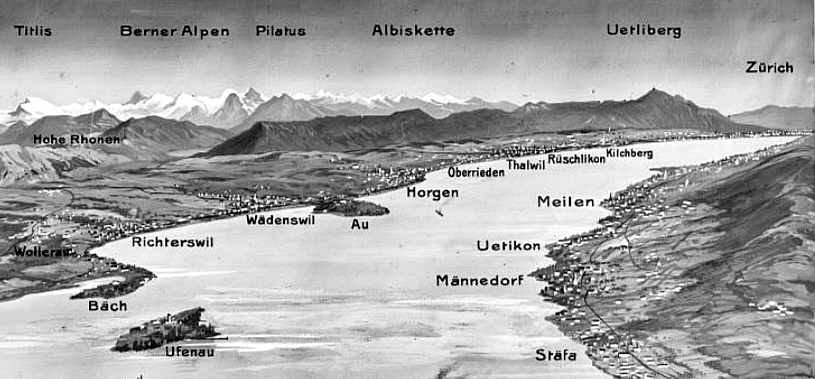
in these surroundings. From yet another vantage point, the splendor of nature surrounds you on the so-called Katze. But you stand on a rampart and look out upon the scene of one of the most significant events of the previous war. From here, one overlooks the key points of the Battle of Zurich between the Russians and the French. On September 25, 1798, it determined the unfortunate consequences of the war for Austria and dashed all the expectations one had placed in the Russians and the glory of their campaign. In a different way, one senses here at the public inn, in the frank judgments about public figures and circumstances, that one is in Switzerland. The most outspoken today was the innkeeper himself. Among other things, he recounted the mischief a French officer had caused in the house. “But by God,” he added, “had I been at home, I would have told him: ‘You are as coarse as your lord and master.’” Lake Zurich, which we sailed across that afternoon, is 10
hours long, though it cannot be seen in its entirety, and is 1 to 1½ hours
wide. Less extensive than Lake Constance, it makes up for what it lacks in
size with the proximity of its two shores. Just as beautiful and richly
vegetated as the latter, and even more densely dotted with villages,
castles, and country houses, it brings everything closer to your eyes that
there is lost in the distance. Every stranger returns from this watery
paradise in delight, and the cheerful disposition and the—albeit somewhat
affected—Swiss warmth of the innkeeper at Küssnacht added to the pleasure
of this afternoon. On the way back, we caught a glimpse of the small Thüreler
See peeking out from between its dark fir trees, and then, for the first
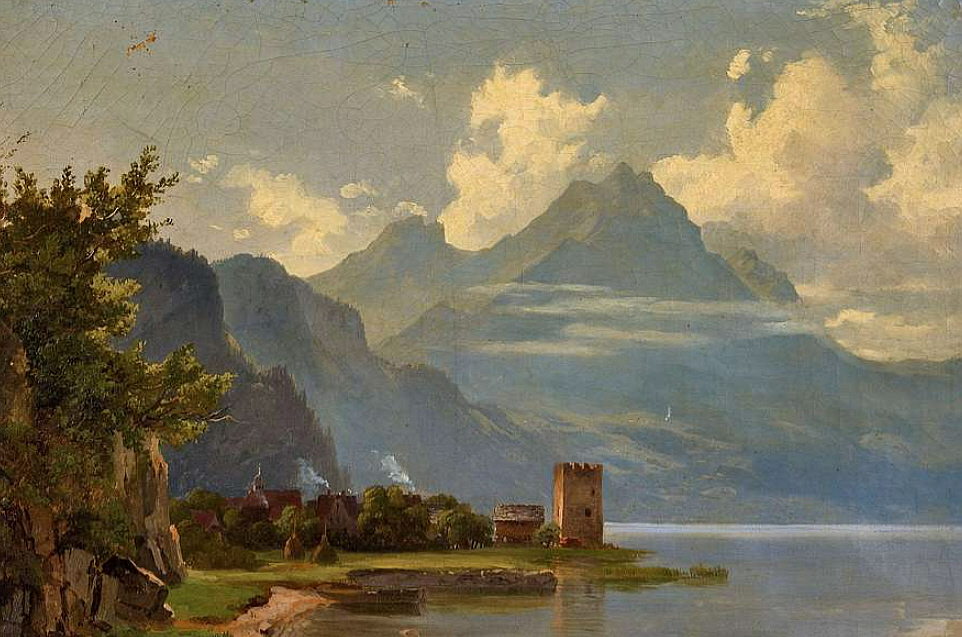
time, savored the sweetness of rest after a hike through the Swiss Alps. Zug itself is the capital of this small, predominantly Catholic canton; a charming little town, it stretches down from the gentle hillside to the waves of its lake. The lake is 4 hours long, 1 hour wide, and at one point 200 fathoms deep. Foggy weather made it inadvisable to head toward the alpine-rich Rigi, which rises from the shore of this lake, with a circumference of 8 to 10 hours, in a pyramidal shape to a height of 4,556 feet above the lake and 5,676 feet above sea level, and is called Culm at its highest peak; on a clear day, the effort of a 5-hour climb is rewarded by the view of 18 lakes, the majestic sight of long chains of the highest snow-capped mountains, and sweeping vistas as far as Swabia and France. We sailed past a vertical rock face of the same, 4,000 feet high according to Ebel, on our way to Immensee. The famous narrow alley leads here to Küssnacht over a
stretch of land that takes an hour and a half to cross. Tell had already
struck the apple on his beloved’s head with one arrow and revealed the
purpose of the other. But the prisons of Küßnacht waited in vain for him.
There was no need for the bailiff to rush to receive him there. Having
leaped from the ship with bow and arrow near Flüelen in the storm on Lake
Lucerne, the archer stood here behind a tree, waiting for the approaching
figure. If ever in history an assassination has been justified by
necessity and sanctified by its consequences as a meritorious deed, it is
this one. At stake were home and hearth, life, wife and child, and the
fatherland. The bailiff rides into the alley, the archer lying in wait
behind the tree. The bowstring whistles; the tyrant lies dead, all is
saved forever, and from this deed, in conjunction with the Rütli Oath,
began the Swiss Republic and freedom, which, through long bloody struggles
from within and without, grew ever stronger, has now existed for nearly
500 years, and has made the Swiss, to this very day, a respected and
envied people in the eyes of all Europe. In memory of this event stands
here Wilhelm Tell’s Chapel, known as “Tellen.” Another can be seen near
Flüelen, where he leaped from the ship. On ours, one reads the following
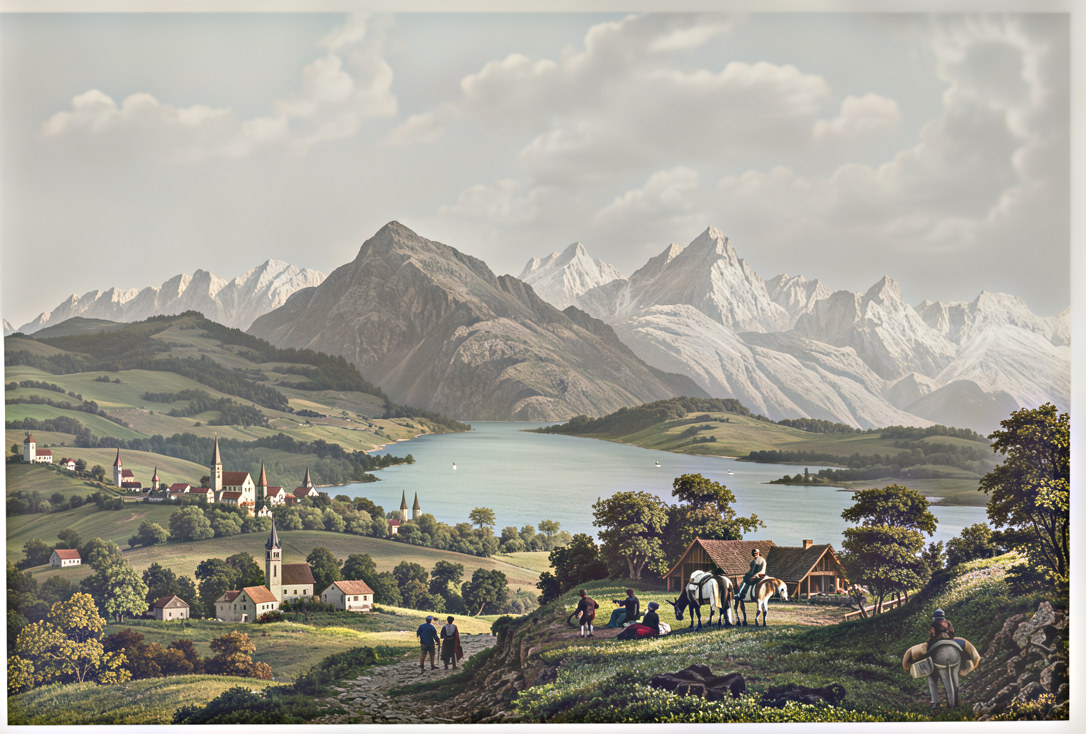
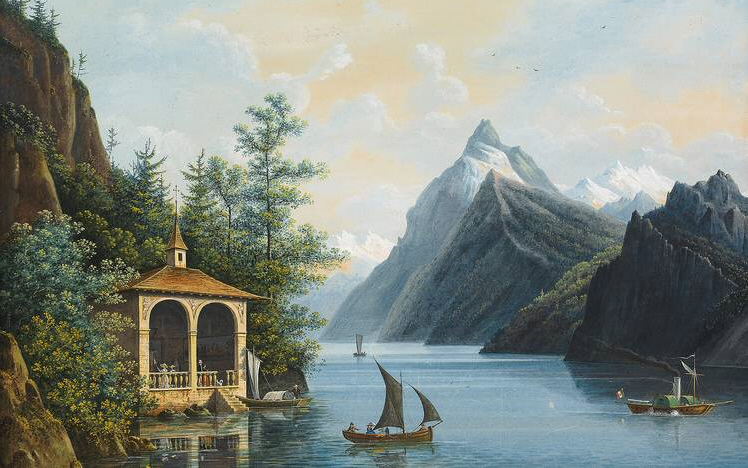
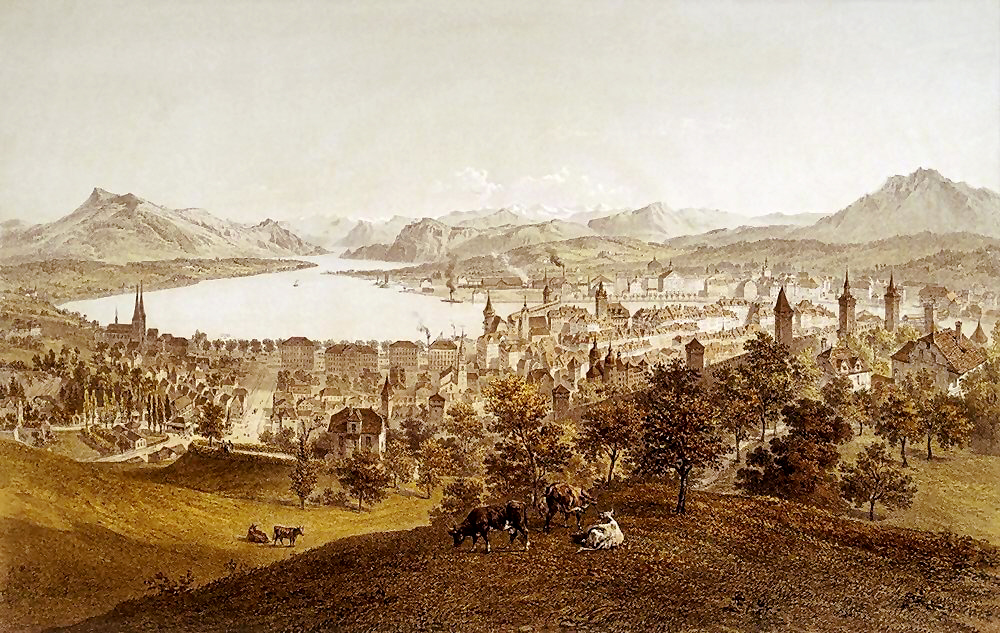
verses: Lake Lucerne, onto which one embarks at Küssnacht (Canton of Schwyz), stretches 9 hours lengthwise from Lucerne to Flüelen and 4 to 5 hours widthwise from Küssnacht to Alpnach. Here, the eye searches in vain for those charming shores, those towns and villages nestled close together, and that lively, cheerful life that once surrounded the Lake of Zurich. But with no less interest, one sails upon these dark waters, recalling the deeds of antiquity to which these shores bore witness, and in this setting of a mountainous world that rises toward the sky, near and far, to heights of 2,000 to 10,000 feet, drawing the clouds down toward itself, and surrounding the lake almost everywhere with black, rugged, steeply sheer rock faces. Ever closer, larger, and more formidable, the giant Pilatus stands before your eyes. At its foot lies Lucerne, already impressive from the outside, and seemingly inhabited on the inside by a cheerful, good-natured, and industrious little people, numbering 6,300, the capital of a canton of the same name and of the Catholic faith. The Reuss, which rises on the Gotthard Mountains and flows into the lake at Flüelen, emerges here again. Several bridges, some of them very long, ranging from 1,000 to 1,300 feet, connect the parts of the city separated by the river and the lake. That very evening, we viewed the topographical map of Switzerland, a magnificent work, in the cabinet of the late General Pfyffer. It measures 20 feet in length and 12 in width, and, as it is displayed here, is too large to provide a convenient and instructive overview. Nevertheless, it covers an area of 60 square miles and presents the highest mountains, reaching 9,700 feet, at a height of 10 inches above the lake. All elevations and depressions, all places, lakes, rivers, and streams, all roads and footpaths are depicted here in their natural forms and curves and in the most precise proportions. It is the work of twenty years of diligent effort by the general himself. In 1577, the skeleton of an elephant or some other
monstrous creature from the animal kingdom was unearthed near Nieden under
an oak tree. In keeping with the beliefs of the time, it was simply and
readily taken to be the remains of an ancient giant, and a painter had the
idea of depicting it in its supposed human form and size, based on the
proportions of this terrifying skeleton. A fearsome colossus. |
|
||||
|
>> 3 Sunday, 1 September. Lucerne to Sachseln. 6 hours. It was entertaining to walk from here to Winkel amongst the cheerful crowd, who, dressed in their finest Sunday best in traditional costume, were strolling towards the town and the church. These simple folk also seemed to take pleasure in our procession. Hundreds upon hundreds marvelled at the magnificent red cap. From Winkel the route leads back along the lake to the shores of Stanz. This part of the lake is not lacking in charming scenery and varied attractions. Further on, the great Mount Pilatus unfolds to the right. The fields between the lake and its steep slopes are charming. Soon, rising majestically from its ashes, Stanzstad greets us in a rejuvenated form; halfway along this route, the first glacier spreads out in the snowy region of Engelsberg, and soon the eye is lost in the gloomy bosom of Alpnach. Between Stanzstad and Alpnach lies the Rothsberg. Yet this region, consecrated by nature as a hidden haven of tranquillity and peace, was the scene of the most horrific atrocities during the last French and Civil Wars. Did not the flames of arson blaze from Stanzstad and all the farms as far as Stanz, across the lake and up the surrounding Alps and snow-capped mountains! Two honest Swiss men, who had fought in the war and were our companions, were able to recount all the events to us and show us all the arrangements on the spot. It is also thanks to them that we met a woman of humble birth but noble spirit and character. Her husband had gone out with the defenders of the country and had fallen in battle. His comrades-in-arms buried him on the battlefield. When he had already been buried for two days, his wife, who had only just learnt of his death, went out into the night, dug him up again, and carried him home to the churchyard. Here he was laid to rest in consecrated ground according to the sacred rites of the Church, yet neither she nor he found peace. For days on end the poor woman now lay upon the grave that held her dearest, praying and weeping, until one night, whilst she was away, the body was removed a second time and secretly buried in another place. She never learnt where they had laid him to rest. One is tempted to think that such a feeling in a woman’s heart, and the man’s virtue worthy of that feeling, could only be possible in Switzerland. But both were foreigners and Germans. Now she lives with a second husband, also a native German, once again in a happy marriage, and the Swiss transferred to him the fulfilment of a promise they had made to the first. They granted him the most precious thing they have to give, Swiss Civil Rights and Freedom. We landed at Rothsloch. Here, the Rothsberg has been breached—probably by an earthquake—from the higher plateau that slopes down to its rear, all the way down to the lake on this side. A murky mountain stream now plunges down through the jagged rocks with a wild roar. We climbed as far up into this mountainous terrain as was possible without danger and necessary to get a view of the most interesting part of this waterfall. Before flowing into the lake, it powers a paper mill. Opposite, one can drink from a sulphur spring. The footpath to Stanz leads round the Rothsberg and then, between scattered rural dwellings linking Stanzstad and Stanz, through a pleasant meadow, surrounded by the foothills of the nearby Alps. The Rigi, which one imagines to be far behind one’s back, stands once more before your eyes with its reverse side. In Stanz, the capital of the canton of Unterwalden, Nidwald, we had lunch in a parlour full of honest, modestly cheerful and courteous country folk. The most remarkable sights of the afternoon are: The Drachenried (dragons reed), the high-lying, somewhat marshy plain between the back of the Rothsberg and the Alps opposite. One is apparently walking here on the bed of a former vast lake, which once, when the Rothsberg burst, found its outlet through the Rothsloch into Lake Lucerne. The Grosshorn rises majestically to the left; chamois graze on its rocky slopes, and above them circles the vulture. From nearby Melchthal, the homeland of Arnold, one of the founders of Swiss freedom, the Melch river plunges down. One can already see Sarnen, the capital of the canton of Unterwalden, Obwalden and Lake Sarnen close at hand, and walks a further stretch along the left bank of the latter past to Sachseln, where it is not advisable to sit next to the chairs. Monday 2 September: Sachseln to Meiringen, 6 hours. Yesterday and again this morning, the beautiful church of Sachseln, adorned with marble columns and altars and widely visited with pious devotion, was viewed. It houses the venerable remains of Saint Nicholas. Niclaus von der Flüe, a member of one of the country’s
most distinguished and prosperous families, was already an old man when,
in accordance with the extreme religious views of his time (he lived in
the 15th century), he left his wife and children—reportedly twelve of them—and
withdrew to the desolate wilderness of the Melchthal valley to spend the
rest of his life as a hermit. Whilst men may disapprove of this step, he
has at least atoned for it through a great service to the Swiss. For at
the hour of the fatherland’s greatest peril, when in 1481 the assembled
Confederates in Stanz were about to part in the deepest bitterness, and
the sword of civil war threatened to destroy the Holy Confederation, then
the hermit Niklas broke his vow and, a noble and majestic figure,
descended from the mists of the Melchthal valley into the assembly like a
guardian spirit of the fatherland; by his mere presence he moved all
hearts, and through the substance of his exhortations united everyone in a
renewed and steadfast loyalty to the Confederation. This was the only time
he was seen among men again during his life as a hermit. After his death,
his body was brought to Sachseln. Few patriotic deeds have been rewarded
by posterity with such a grateful and pious remembrance as his. Ceaseless
pilgrimages take place to his grave and to his hermitage. Many call him
simply Father Claus, or Brother Claus. The whole of Unterwalden is proud
of his name. Catholics speak of him only with reverence, whilst all
other Swiss speak of him with gratitude and respect. One can see here: Further along the left bank of Lake Sarnen, all the way up
to Gyswyl, one can admire many waterfalls plunging down from the high,
rugged mountains. In Gyswyl, we made the acquaintance of an interesting
young man. In the year 1800, he served as a first lieutenant with the
Swiss auxiliary troops in the Heidelberg, Mannheim and Durlach area; he
gave us some brief insights into the events of that time, revealed himself
in his speech to be an honest, sensible man, and now, like the defenders
of the fatherland in ancient Greece and Rome, makes his living from his
trade. He is – a shoemaker. Nowhere does one feel more closely and
pleasantly surrounded by Swiss honesty and good-naturedness than in the
Canton of Unterwalden, and what in a certain other canton might rightly be
called Swiss coarseness dissolves, as one travels through the cantons of
Zurich, Zug, Schwyz and Lucerne, dissolves here into a charming, sincere
simplicity, combined with a refined, natural sense of decency towards
strangers. An hour’s walk beyond Gyßwyl, the 'Kaiserstuhl' (Emperors Chair)
rises high to the plain of Lake Lungern. Even as you walk along its shores
(it takes an hour to walk the length of the lake), you are constantly met
with the sight of the waterfalls plunging down from both sides of the
mountains and the sound of their roar, whether near or far. From Lungern
at the end of the lake, the path begins its descent over the Brünig Pass
towards Meiringen, a further three-hour walk. The customs house at the
summit marks the crossing into the Canton of Bern. It is a pity that, of
all places, a wild bank of fog deprived us of the view of the high
mountains opposite and the first beautiful glimpse into the charming Hasli
Valley. Worse still, it soon turned into a heavy downpour, which
accompanied us right to the doorstep of the inn in Meiringen. There we lit
a fire and changed our clothes, dried off and washed, ate and drank,
laughed and grumbled. If the fog on the Brünig was thick, the dreadful
smoke in the room was even thicker now. Yet we were not deprived of the
view of a few waterfalls out of the window, nor of the beautiful, freshly
snow-capped peak of a mountain that seemed barely a quarter of an hour’s
walk away. |
|
||||
|
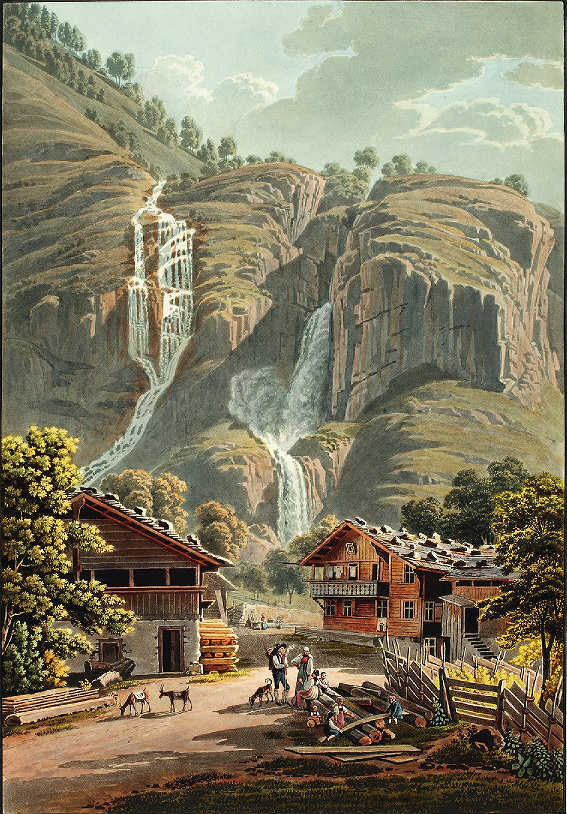
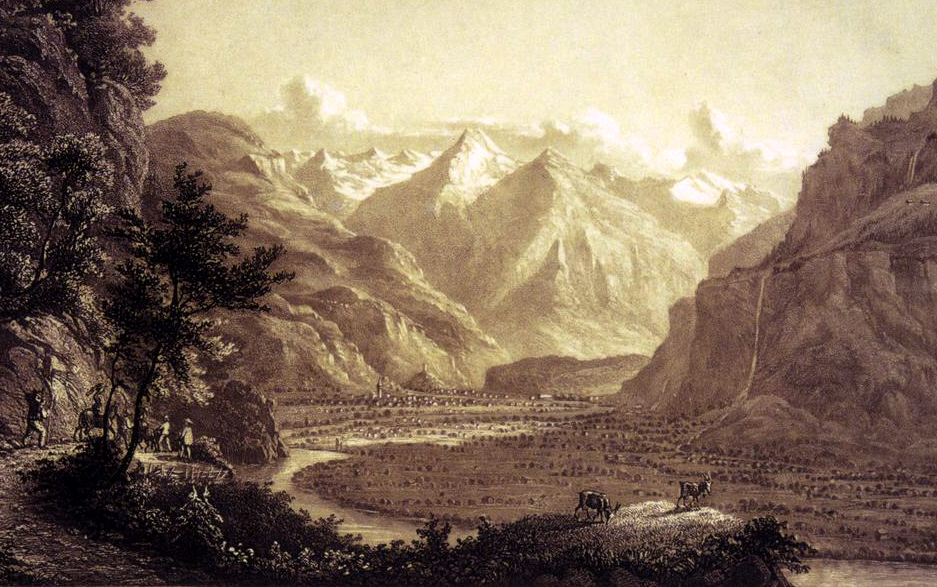
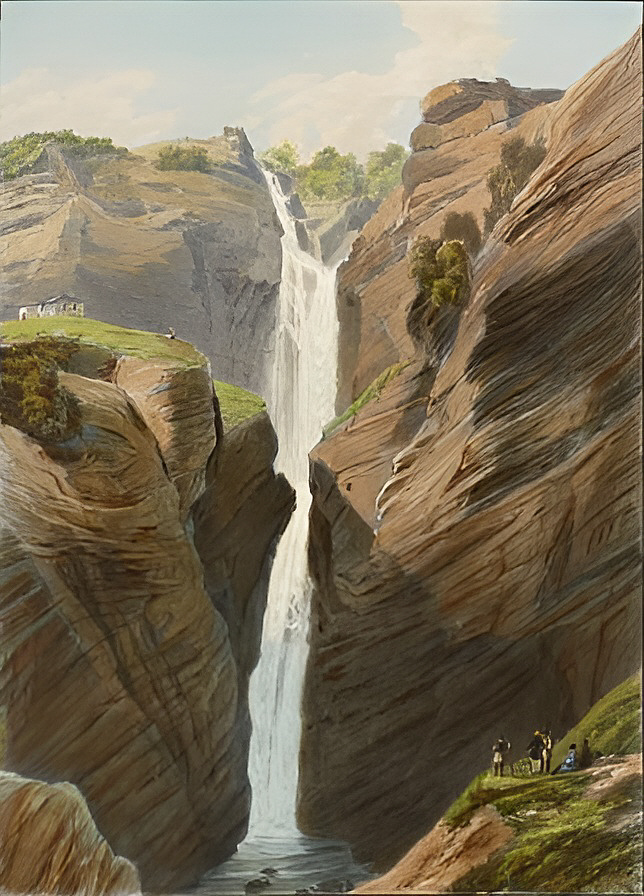
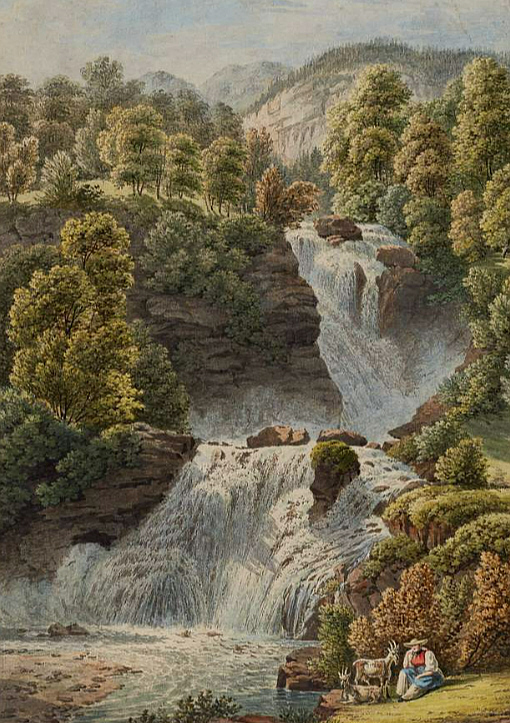
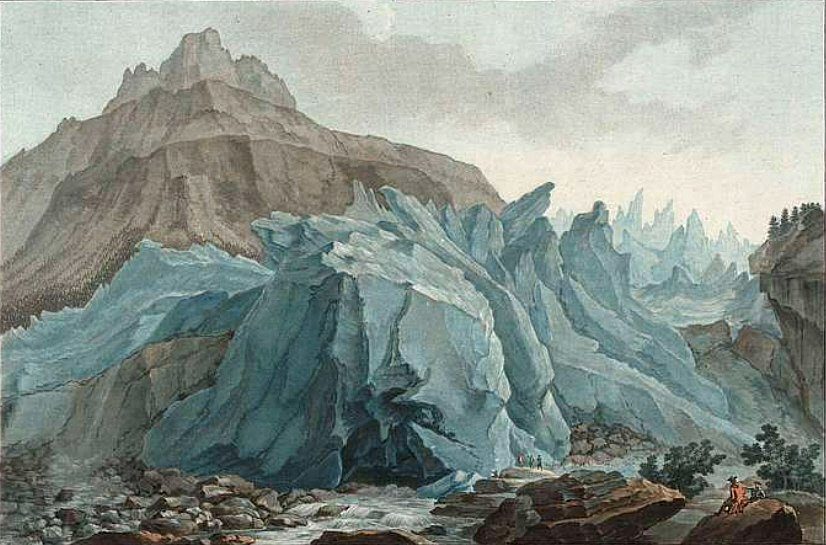
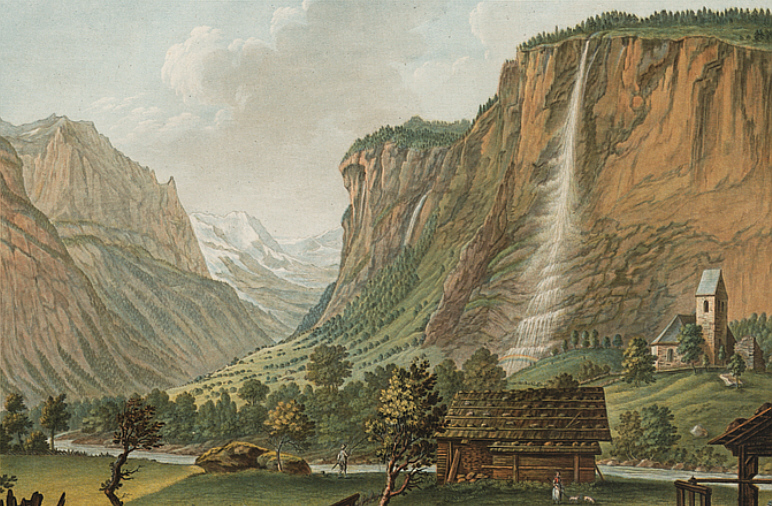
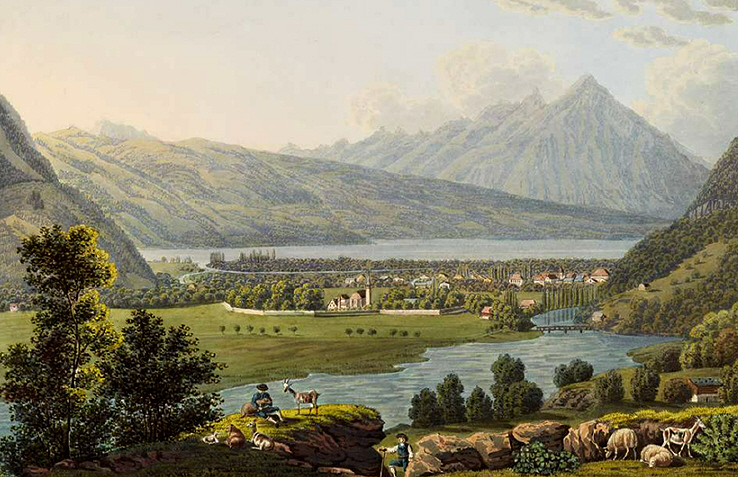
>> 4 3 September. Maieringen. Maieringen, also known as Hasli, is a beautiful and large village in the much-visited and highly praised Hasli Valley, which is surrounded by high mountains and beautiful Alps, rising up into the Grindel region, flowing downwards through the youthful River Aare, and opening out into the Interlaken plain, between Lake Brienz and Lake Thun. The inhabitants of this valley are said to distinguish themselves from all other Swiss in spirit and physical stature. Their language is described as the finest of the entire Swiss people. It seems, however, that one must spend more than a day in this region, which in any case directs one’s attention to other matters, to find this to be true. Yet something distinctive in the character of the Bernese rural folk does not escape notice. The open sincerity of the small cantons is concealed behind a more serious, at times almost ponderous exterior. The prosperous Bernese is conscious of himself and his prosperity and takes pride in the canton to which he belongs. In contrast, the poor man beside him seems to have lost the sense of being Swiss, at least in these valleys. Even the naive and irresistible manner of the lads from Unterwalden, when they surround the traveller in their villages within a few seconds with a stout old man, and with cheerful gestures, sweetly and charmingly vie for a few kreuzers to play with the crossbow, sinks here to the most vulgar and brazen begging in the German manner. Yet nothing is more difficult than to judge, without prejudice, the character of a people one merely passes through, as if on a country road. A clear sky hung above us when we awoke today, and bathed in the glow of the morning sun, the Schneeberg welcomed us. The morning was spent on occasional walks to the nearby sights of the valley, particularly the waterfalls. Baron Ernst preferred to wash at a waterfall today rather than in his room. So be it! One comes so close to the lower cascade of one waterfall, amidst a spray of water painted in all the flying colours of the rainbow, that, as if served by invisible spirits, one’s head and hands become wet in a matter of seconds, and one can cleanse and refresh oneself without reaching out for a single drop of water. In the afternoon, we visited the distant and remarkable cascade of the high Reichenbach. It is divided into the lower, middle and upper sections. Today we reached the middle section, where we made our first acquaintance with Mr Lafond, a very agreeable man and skilful painter from Bern. One lingers here in surprise and wonder at the manifold views—by turns picturesquely beautiful, by turns terrifying and gruesome—in these wild, thunderous gorges, once again surrounded by all the beautiful colours of the iris. For entertainment for the rest of the evening, we found newly arrived company at home. It is an extremely interesting surprise, when one finds oneself in these lonely mountain regions, feeling somewhat melancholy at being cut off from all civilised, and often from all human, society, to come across a sketching artist here before a sublime subject, to meet an undaunted botanist on a lonely path, and to see strangers from all corners of Europe passing by here and there, or to join them at the inn. 4 September. Maieringen to Grindelwald. 9 hours. How small man is here, and yet how great is the power he can muster. Strasbourg Cathedral is 490 feet high, the Wetterhorn 11,450, the Eiger 12,260, and the Vieschhörner even higher. Rarely does one have the misfortune of leaving here without hearing of avalanches. That very evening we heard a sudden distant roar and, just in time, caught sight of a column of snow crashing down the Wetterhorn. We also heard the distant, muffled crash and rumble of another one plunging down on the other side. I shall not reveal what else happened that evening. But another living curiosity in Grindelwald is Annelis’s father, our innkeeper himself. The glaciers have wide crevasses here and there, reaching down to the deep abyss. Whoever falls in is at God’s mercy. Yet this happened to our innkeeper. His companions called down into the depths. No answer! Ropes were lowered, tied one to another. No hand grasped them. He was mourned as dead and given up for lost, when on the third day, like a visitor from the world of crevasses, he returned alone through the village to his home. When, in the dreadful ice dungeon that held him captive, he had come to his senses from the numbness, he heard the murmur of a nearby underground stream, crawled after it with his body crushed and his arm broken, and emerged with it at the foot of the glacier into the joyful light of day and life—the only example of such a rescue. 5 September: from Grindelwald via Lauterbrunn to
Interlaken. 7 hours. The path leads back to Zweylütschinen. With a longing gaze and a sense of imminent hope, one finally looks out once more towards the lower mountains, the broader valleys and cultivated fields, and finds oneself in Interlaken, between Lake Thun and Lake Brienz, back on the banks of the Aare, and at the mouth of the valley that one had cut through from the Brünig Pass down to Meiringen. It was here, on 15 August this year, that the great Swiss
Shepherds’ Festival was held for the first time, an event which has
dominated the pages of all this month’s newspapers. The day was filled
with competitions of every kind. This was a true display of the Swiss
spirit and character. One man from Appenzell, for example, who had only
recently recovered from a serious illness, lifted a stone weighing 1,801
pounds with one hand above his head and, keeping his body still and using
only the strength of his arm, threw it 10 paces away. He then wrestled for
another half an hour with the strongest competitors. When, at the end,
after a hasty drink, he was overcome by nausea and could not accept the
prize he had won, his defeated opponent, also an Appenzeller, stepped
forward; proud of his countryman, he accepted the prize on his behalf and
presented it to him with joyful sympathy. |
|
||||
|
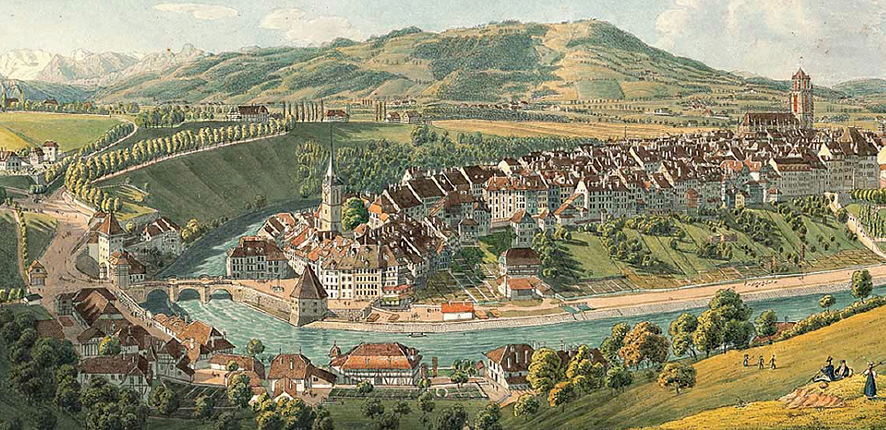
>> 5 6 September, Interlaken–Thun. 6 hours Mr La Fond had also arrived this morning. After returning from a walk to Lake Brienz, we visited Mr König, also a skilled painter, in the town of Unterseven during today’s journey, and viewed his beautiful works depicting Swiss landscapes and traditional costumes with great pleasure. Soon one stands on the shore of Lake Thun. It is four hours long, one to two hours wide, and is bordered by high, partly steep mountains, among which the Vorgebirg, known as the ‘Nase’, the Beatenberg and the beautiful, regularly shaped Niesen deserve special mention. At the end of the lake, where the Aare flows out again, stands Thun, a pleasant provincial town of the canton. The high-lying churchyard offers a view well worth seeing. The White Maiden gazes proudly across. Here the long journey on foot comes to an end. The 7th: Thun to Bern. 6 hours. On this journey we made the acquaintance of the learned and very agreeable Professor Kuhn of Bern. What the region lacks in other curiosities, it makes up for in diversity, embellished by culture. Passing through imposing villages—built of wood, yet large and richly constructed—one soon arrives at artistic and tasteful developments, the harbingers of the nearby town. This evening, our faithful companion Hofmann was dismissed. 8 and 9 September, Bern. Bern, situated in a narrow but pleasant valley and surrounded by the River Aare, is the most beautiful and one of the largest and wealthiest cities in Switzerland. The entire length of the main street, which is not entirely straight, is lined throughout with houses built of solid ashlar, with arcades on both sides. Duke Berthold V of Zähringen founded the city in 1191. Now, with 13,680 inhabitants, it is the capital of the largest and most powerful canton, of the Reformed faith. On 8 September, as it was the great Swiss Day of Repentance and Prayer, we spent most of the day in quiet reflection in our room and on the promenade, for example by the lovely little deer, and in the high churchyard. Here too, the Virgin Mary greets you. On 9 September, accompanied by Madame Haller, we visited 1. the library. Among other things, it houses valuable portraits of former heads of state, full of character and life. 2. A large tableau depicting the Resurrection, with
several interesting details. Tuesday 10 September: Bern to Biel, 6 hours This morning we visited Mr Lafond at his home and saw, in
part, his own Swiss landscapes and traditional costumes, drawn with taste
and fidelity, and, in part, several coloured engravings and hand drawings
by his famous teacher Freudenberger. Shortly before Bern, we came across a
nose today. The largest that could possibly fit on a human face, yet
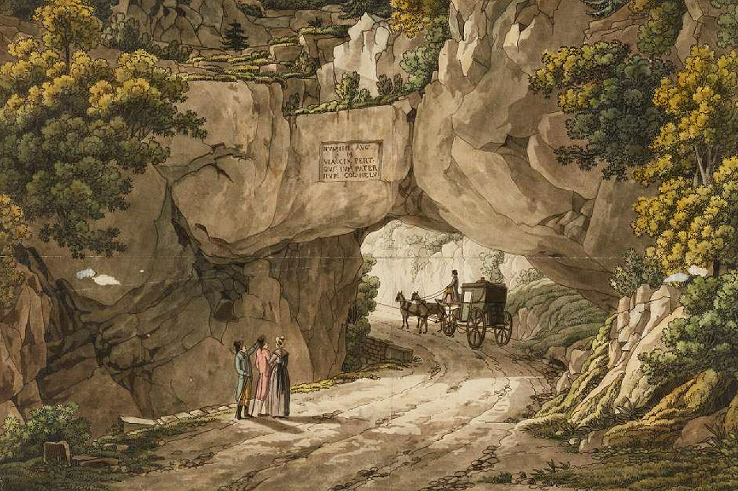
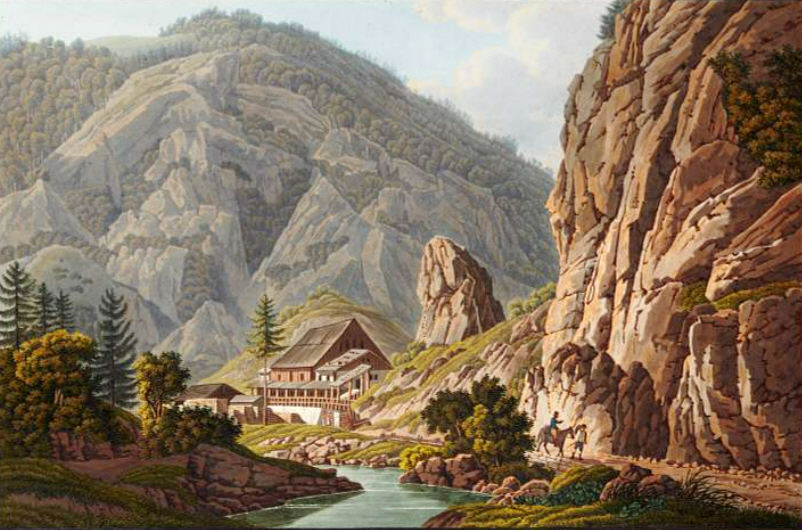
smaller than the promontory of the same name in Lake Thun. Biel, formerly a member of the Swiss Confederation, is now a French border town belonging to the Department of the Upper Rhine. A quarter-hour’s walk led through a poorly maintained promenade to Lake Biel, 8 hours long, 1 mile wide, and 216 feet deep. From its shore one can see Peter’s Island, made famous by Rousseau’s name. Running down towards the lake and the town are the Jura Mountains, which stretch far from France, running from Geneva to Basel along the border between Switzerland and France, and here form a beautiful, wide valley with the Frienisberg opposite. We entrust ourselves to its rocky gorges. Wednesday the 11th, Biel-Mallerai. 6 hours Mr Lembke, a fellow countryman and acquaintance, was our pleasant companion today. The path climbs quickly and steeply up the Jura, where once again one catches sight of the distant snow-capped mountains stretching out in a long line, and then winds its way along its rocky slopes, with the rising ridges to the right and a precipice plunging into the depths to the left, where the river rushes by, now invisible, now coming into view in larger and smaller waterfalls. Dark firs clothe the rocks. Suddenly, the gentle Imer Valley pleasantly interrupts the
solemnity of the mood evoked by these surroundings. One crosses it at
Sonceboz and climbs the second range of mountains, over whose ridge one
passes through the Pierre Pertuise rock arch. A neighbouring, higher
mountain ridge descends here across the road. It was probably the Romans
who cut through it. Through an opening 40 to 50 feet high, one passes
through to Tavanne (Dachsfelden). On this side of the rock stands a Roman
inscription, now almost illegible, which is interpreted as follows: Immediately beyond the rock, one catches sight of the source of the Birs, our faithful companion all the way to Basel, and travels through a hilly landscape between gentle mountains towards Mallerai, a rather shabby village with a similar sort of inn. Mr Lembke, who had already left us to return to Biel by chaise, came back a few hours later as a prisoner, and had to stay on after his release, as evening was already falling. It was fortunate that he still met us; otherwise he would have been taken to Besançon under military escort, and Mr von Bobenhausen would probably never have seen his parcel. 12 September, Mallerai–Delémont. 5 hours. Today we travelled on foot again. Even Mr Lembke, who had settled himself comfortably and at his leisure in the carriage yesterday, humbly walked the 6-hour journey back on foot. Joshua, the famous commander, is said to have once commanded the sun during the battle of Jericho. There it stood still over Jericho, and the moon in the valley of Ajalon. A certain gentleman wanted to attempt something similar today and command them out of the fog. But he did not succeed until *)...*) Unfortunately, at this point and in a few others, the notebook in which Hebel wrote his travelogue is damaged. The Münster Valley. A majestic sight! For two and a half hours you walk along the base of jagged mountains through a winding rocky gorge, which at the bottom leaves room only for the road and the rushing River Birs. Close to the edge of the first gorge and on the banks of the last, the wild, jagged rock masses tower up; at the top, they soon recede into deep expanses or hover as terrifyingly protruding masses above the hiker’s head, threatening to block out the sky. At the smelting furnace of Corrandelin (Tennedorf), one emerges once more onto a confined plain. Here lies Delémont (Delsperg), the principal town of this region. It was formerly part of the Diocese of Basel, but had its own constitution and was allied with the most powerful cantons of Switzerland. The people who inhabit it enjoy a fine reputation for the warmest good nature and honesty. Since the early years of the last war, their documents of liberty and confederation have been torn to shreds, and the French eagle now spreads its wings over their valleys and rocks. From Biel onwards, the language is patois. 13 September. Delémont to Basel: 9 hours. To the right, one can still see Arlesheim, the former seat of the Basel Bishop’s Cathedral Chapter; nearby lie the ruins of Münschenstein Castle, which was destroyed by the fury of the Revolution only a few years ago, and one passes close by the battlefield of St. Jakob. In 1444, 1,600 Swiss defended their homeland against 30,000 Frenchmen. Eight thousand enemies fell on the battlefield. Only 16 Swiss survived. Their homeland declared them dishonourable cowards. The red wine that now grows on the battlefield is therefore called ‘Swiss Blood’, and is drunk away in a few days every spring amidst patriotic memories and sentiments. Here the Birs flows into the Rhine. 14th–15th, Basel. It is the largest city in Switzerland and has the most
extensive trade; it is the capital of a Reformed canton. Here we reached
the Rhine again for the first time, having left it at Constance, and were
18 hours’ journey from Schaffhausen. On the morning of the 14th, we
visited: 1. The Town Hall. 2. The Minster Church, notable for its tombs
and monuments to figures from the Austrian and (missing) houses, to
bishops and (missing) the families of Rothberg, Reichenstein, etc. In the
choir stands the tombstone of Erasmus of Rotterdam. 3. The great
auditorium of the university. 4. The hall of the church assembly. It was
moved here from Constance. 5. The cloister behind the church and the
palace with a beautiful view. The rest of today and the following day were
spent with friends in the countryside at Bourgliore and Weil. |
|
||||
|
The stages and costs of the Swiss journey - |
The translation of the further information into English is currently in progress and will be available in the near future. |
||||
|
|
|
nach oben | |||
|
Visit the brilliant special
exhibition: |
|
||||