|
How Freddy Tinder made himself mounted
(Wie sich der Zundelfrieder hat beritten gemacht)
1813
When Freddy Tinder had soon gone through all manner of cunning thieving
tricks, and had almost come to a real head over it—for Freddy Tinder
never steals out of necessity, or greed, or debauchery, but out of love
for the art and to sharpen his wits—did he not himself tie the grey
horse back to the door for the miller of Brassenheim? What more could
the kind reader or the house friend’s travelling companion to Lenzkirch
ask for? One evening, when he had, as mentioned, tried almost everything,
he thought: ‘Now I want to try, just once, how far one can get with
honesty.’ So that very night he stole a goat, three paces from the night
watchman, and allowed himself to be caught. The next day, during
questioning, he confessed everything. But when he soon realised that the
judge intended to give him twenty-five or so as a keepsake, he thought:
‘I am not yet honest enough.’ So he got a little tangled up in his words
and, after a brief resistance, confessed during further questioning that
he had always been a bit of a night owl, that is, a person who sees
almost better at night than by day; and when the judge tried to put him
on the spot to see if he knew of a few other thefts that had recently
been committed, he said, he did indeed know of them, and that he was the
one responsible. When, the following morning, the verdict was read out
to him—that he was to be sent to prison—and the town soldier who was to
escort him was already standing at the door, for it was a twenty-hour
journey, he said, quite contritely: “Justice finds its servant. What I
have earned, I shall receive.” On the way, he told the town soldier that
he had also been in the military. “Did I not serve for six years in the
Klebeck Infantry? Could I not show you seven wounds from the war of
separation that Emperor Joseph wanted to wage against the Dutch?” The
good-natured companion said: “I never managed to get any further than
being a city soldier. Actually, I was a nail smith. But times are hard.”
- “On the contrary,” said Freddy, “a city soldier is more respectable to
me than a field soldier. For the city is more than the field; that is
why the field soldier, in his old age, still advances to become a city
soldier. Moreover, the city soldier guards the lives and property of his
fellow citizens, his own wife and child. The soldier of war goes into
the field and fights, not knowing for whom or for what. Furthermore,” he
said, “a city soldier, provided he has committed no misdeed, may die
with honour whenever he wishes. We, on the other hand, have to let
ourselves be stabbed to death. I assure you,” he continued, “I and my
enemies”—he meant the Roperiders—“we derive little honour from the fact
that I am still alive.” - The blacksmith was so moved by this honourable
comparison that he thought to himself he had rarely had to escort such a
kind and condescending prisoner, and Frieder always strode ahead with
long strides to make the blacksmith thoroughly tired and parched in the
scorching heat. “That is how field soldiers differ from city soldiers,”
he said, “in that they are used to a long stride from marching.” At 4
o’clock in the evening, when they came to a little village and a tavern,
“Comrade,” said Freddy, “shall we not have a pint?” - “My friend,”
replied the nail smith, “whatever suits you suits me too.”
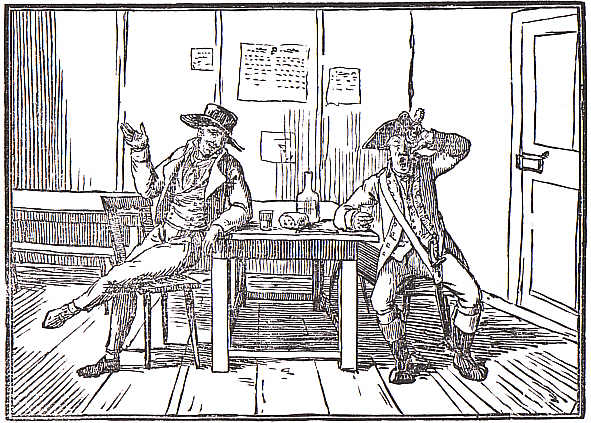
So they drank a glass together, then half a pint, then a pint, then two,
and became brothers in the process, and Freddy went on and on about his
war exploits until the nail-smith fell asleep, overcome by the weight of
the wine and weariness. When he woke up again a few hours later and saw
that Frieder was nowhere to be seen, his first thought was: “What’s this?
My good brother has gone ahead of me!” No, he was just standing a little
way outside the door, for Freddy does not easily leave empty-handed.
When he came back in, he said: “My good brother, the moon is about to
rise. If it’s all right with you, we’d better stay here for the night.”
The nail smith, sleepy and sluggish, said: “As you wish, my good brother.”
During the night, whilst the nail smith slept soundly and all sounds
snored from bass to treble and back to bass again, but Freddy could not
sleep, Freddy got up, rummaged through the brother’s pockets for a
pastime, and found, among other things, the letter that had been given
to him by the town soldier to take to the prison warden. Thereupon, for
the sake of passing the time, he tried on his brother’s new riding boots.
They suited him well. Thereupon, for the sake of passing the time, he
let himself down through the window onto the street and walked straight
away, as far as the moonlight carried him. When the blacksmith woke
early and saw no sign of the gentleman’s brother, he thought: "He’ll be
out for a bit again." Admittedly, he was a bit outside again, and when
he had walked the day, in the first village he came across, he woke the
village reeve. “Mr Reeve, a misfortune has befallen me. I am a prisoner,
and the town soldier from such-and-such a place, who was supposed to
escort me, has gone missing. I have no money. I know neither the way nor
the path, so have a soup cooked for me at the public’s expense and
provide me with a guide to the town and the prison.” The mayor gave him
a voucher for the village inn for a bowl of flour soup and a jug of wine,
and sent for a poor girl. “Go to the inn, and when the man having
breakfast there has finished, show him the way to the town; he wants to
go to the prison.” When Freddy had come out of the forest with the girl
and over the last hills, and had spotted the town’s towers from afar on
the plain, he said to the girl: “Now just go home, my child; I can’t go
wrong now.” In the town, by the first houses, he asked a young lad in
the street: “Young lad, where is the prison?”, and when he had found it
and come before the prison warden, he handed him the letter he had taken
from the nail smith’s pocket. The warden read and read, and finally
looked at Freddy with wide eyes. “My good friend,” he said, “that is
quite right. But where, then, is the prisoner? You are supposed to be
delivering a prisoner.” Freddy replied, quite taken aback: “Well, the
prisoner—that’s me.” The steward said: “My good friend, it seems you’re
trying to be funny. We don’t joke about such things here. Admit it, you
let the prisoner slip away! I can see it from everything.” Freddy said:
“If you can see it from everything, then I won’t deny it. But if Your
Excellency,” he said to the steward, “would be so kind as to provide me
with a mounted man, I’m confident I can still catch that vagabond. For
it’s barely been a quarter of an hour since he slipped from my sight.” “Simpleton,”
said the steward, “what use is the speed of the horse to the rider if he
is to ride against a man on foot? Can you ride?” Freddy said: “Was I not
a Württemberg dragoon for six years?” “Good,” replied the steward, “we
shall have a horse saddled for you as well, and at your own expense;
take heed next time,” and in haste he provided him with an open notice
to all local officials, so that should he require a party for the patrol.
So the Roperider and the Freddy Tinder rode on together to find the
Freddy tinder, until they reached a crossroads. At the crossroads,
Freddy told the Roperider which way the Roperider should ride, and which
way he himself intended to go. “We’ll meet again by the Rhine at the
crossing.” But as soon as they had lost sight of one another, Frieder
turned right again and caused a commotion in every village with his
proclamation, ringing the alarm bells to warn that Zundelfrieder was in
the area, right up until he reached the border. At the border, however,
he gave the little horse a kick and rode across.
Something like that could never happen in this country.
|
|
