zurück |
The Literary Encyclopedia. Volume 1.4.1: German-language Writing and Culture: Germany, 500-present.
|
|
|
Johann
Peter Hebel
|
||
|
Val
Scullion (PhD) Independent scholar, Buckden, United Kingdom
|
||
|
Johann Peter Hebel (1760-1826), born in Basel, Switzerland, to parents in the service of the aristocratic family of Iselin-Ryhiner, was made Prelate of the Lutheran Church in Baden in 1819. His social rise was achieved through education, teaching and writing. His two most famous publications are Alemannische Gedichte (1803) and Schatzkästlein des rheinischen Hausfreundes (1811). Hebel’s father was a batman to Major Johann Jakob Iselin, an officer in the French army. His father died when Hebel was only two years old. His mother, a servant for the Iselin-Ryhiners, lived alternately six months in summer with the Iselin family in Basel and six months in winter in Hausen im Wiesental, with the result that Hebel’s early schooling took place in both town and country and was influenced by the standard Swiss German of the time and his local dialect of Alemannic. As Forster argues, early nineteenth-century Baden was likely to have been “in a situation of diglossia – in which the dialect is the normal vehicle of everyday life for educated and uneducated alike and literary language reserved for special functions” (Forster, 1975, 62). Hebel also regularly met people from many social backgrounds, artisan and nobility alike. His mother died when he was thirteen, which had a profound effect on his perceptions. The sale of his mother’s house in Hausen, together with support from the Iselin family, enabled him to continue his schooling, and, in 1774, he went to the Gymnasium in Karlsruhe. Thereafter, he studied theology and was ordained in 1782. He was not, however, successful in gaining a parish, so he became a school teacher in Lörrach. After ten years, he moved back to his old school in Karlsruhe as headmaster and spent the rest of his life in that role. He was a talented teacher with a gift for languages, geography, science and botany, and he had a great store of miscellaneous knowledge. In 1798 he was awarded a Professorship of Theology and Hebrew. Part of his work in this position was to compose prayers, revise the catechism and preach. His congregations naturally consisted of many different kinds of people, so his rhetorical skills and the art of speaking clearly became finely tuned. His guiding principle was: “Was ist denn schreiben mehr als reden?” (How is writing anything more than speaking?) (Hebel, Briefe, 29). This, of course, oversimplifies the subtlety with which he wrote in order to imitate speech. Hebel was fascinated by the dialect of Alemannic, the language of his childhood spoken in the area of southwest Germany, Baden, Alsace and Switzerland. He made several trips back to the Black Forest and Basel at the turn of the century, and, with an educated audience in mind, composed poems in an “elevated, elaborate form” of the Alemannic dialect, “created from memory” (Scullion, Reappraising Johann Peter Hebel, xii). An anthology was published in 1803, and reprinted four times during his life, under the full title, Alemannische Gedichte für Freunde ländlicher Natur und Sitten (Alemannic Poems for Friends of Rural Nature and Customs). The poems display Hebel’s knowledge of classical poetic forms, biblical learning and his immersion in the culture of highly educated scholars. At the same time, the poems maintain a conversational tone which belies their underlying literary artifice. There is an almost complete lack of abstract concepts in them, and a high use of dialogue. The most famous poem in this collection is “Die Vergänglichkeit: Gespräch auf der Straße von Basel zwischen Steinen und Brombach, in der Nacht” (Transience: Dialogue on the Road from Basel between Steinen and Brombach, at Night). The setting is both specific and symbolic, suggested by its reference to the frieze of The Dance of Death, no longer extant, for which Basel was famous. The poem comprises a conversation between a father and son as they drive their oxcart past the ruinous Rötteln Castle on the hill above them. This prompts the boy to ask whether their own hilltop house will one day crumble to ruins in the same way. The father’s answer is that everything and everyone will die, but that people will pass along the Milky Way, meeting friends and family on their journey to an eternal city. The poem stemmed from the tragic circumstances of Hebel’s mother’s death. She was in Basel with her thirteen-year-old son when she became fatally ill. Sent home on a cart with the young Hebel, she died on the journey at the very location of the poem. Nevertheless, the poem transcends the concrete and local detail of his personal experience by addressing common human anxieties. The father does not frighten his son, but rather, in their shared language of Alemannic, explains to him his belief in the working of the cosmos and his Christian faith. With each of the boy’s questions, he works his way from their immediate surroundings to the stars in the Milky Way, where people will be reunited with those who have gone before and will look down on a ruined earth. “Die Vergänglichkeit” comes full circle in the last line, when the father urges his oxen onwards so that they can deliver their load. The directness of dialogue rules out any pastoral sentimentality, and its poeticism is subtly hidden. The metre is blank verse, which lends it rhythm, while the lack of end rhyme suggests naturalised speech. The narrator’s voice also creates rhythm and form by breaking the metre of the dialogue with a repeated “Der Bueb seit” (The boy says) and “Der Aetti seit” (The father says). Addressing the oxen at the end, “Hüst Laubi, Merz!” (Trot on, Laubi, Merz!) grounds the poem in the particular and indicates, both literally and metaphorically, a new journey to come. The father’s description of the afterlife is intelligent and dignified, but, in addition, a contemporary educated reader would not miss Hebel’s biblical reference to the watchman in Ezekiel, Chapter 33: 1-7, who will give warning of the Day of Judgement, and the connections of this chapter with the Book of Revelations, Chapter 18. Hebel’s description of the watchman switches from Alemannic, spoken by the father, to the standard German of Luther’s Bible: Er funklet wie ne Stern,
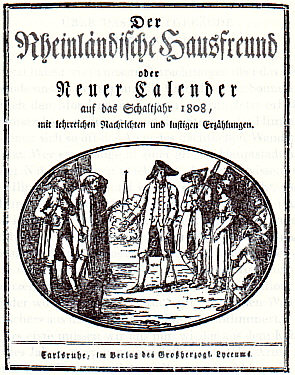
und rüeft: “Wacht auf! (Hebel, “Die Vergänglichkeit”, 284) Here Hebel wears his learning lightly. The inclusion of many voices in his poem sounds entirely unforced and apparently simple, while at the same time exploring profound matters of eschatology. Schatzkästlein des rheinischen Hausfreundes (A Little Treasure Chest of the Rhineland Household Friend), Hebel’s other most famous work, is a compendium of short pieces in standard German. Written with a different audience in mind from his dialect poems, but once again imitating the spoken word, they were selected from the Baden Lutheran almanac in which Hebel had placed them alongside the functional calendar dates. The variety of genres in the Baden almanac included fictional narratives, anecdotes, riddles, reports of recent historical events and famous people, practical instructions, moral fables, and descriptions of animals, plants, natural science and the planets. With such a miscellany, the tone varies enormously, ranging from grotesque comedy, to sharing useful knowledge, to serious moralising. Hebel incorporated these pieces into the almanac for enrichment and entertainment, according to the remit of the Grand Duke of Baden, Karl Friedrich, who wished to foster education in all his subjects. He entrusted Hebel and a small committee to rebrand this loss-making publication and update its ancient generic traditions. In 1806 Hebel brought about improvements which rendered the almanac easily accessible to readers with little education. He was appointed its editor from 1808 to 1811. Under the new title, Der Rheinländische Hausfreund (The Rhineland Household Friend), it became profitable and very popular beyond Baden, both in its almanac form and in selective reprints. Schiller’s wife, for example, reported that Goethe was moved to tears when he read the almanac story, “Unverhofftes Wiedersehen” (Unexpected Meeting) (Goethe, 612). These short, predominantly prose, pieces, known as Kalendergeschichten, have a uniting feature in the voice and persona of the narrator/author. Using a conversational tone and mixing information, stories and proverbs, most Kalendergeschichten present the narrator explicitly as the Hausfreund of the calendar title.
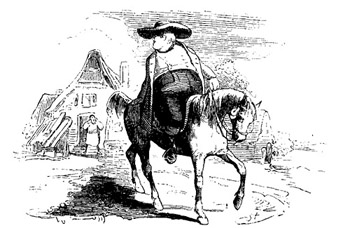
The cover of the calendar, which depicts the household friend speaking to a gathering of listeners, gives a good indication of this persona created through Hebel’s writing. In a practical sense, the calendar did become a family friend, and was one of only two publications, together with the Bible, which was widely possessed by the labouring classes. Many of the fictional narratives in the calendar were illustrated by woodcut prints, which made it completely inclusive, even for those who listened to others reading them aloud. The short narratives and anecdotes in Schatzkästlein are not original, but Hebel imbues them with a flavour all his own, which often features comic or dramatic events. Franz Kafka liked them so much, he is said to have carried the little treasury around with him in his pocket (Forster, 1975, 61). These tales invariably tell of the wit and agency of the underdog, and, as Lee observes, they celebrate hope while acknowledging pain and setbacks in an unpatronising manner (Lee, 2015, 521-23). Many conclude with a moral, following the imperative “Merke!” (Notice!). Two examples, “Gute Antwort” (Good Answer) and “Unverhofftes Wiedersehen” (Hebel, 2008, 139 and 234), will suffice to indicate their variety. Firstly, at just under eighty words, “Gute Antwort” typifies wit and brevity. A rider with a grotesquely large stomach resting on his horse’s withers rides past an inn. The innkeeper calls after him “Why is your pack strapped in front of you and not behind?” He shouts back, silencing the innkeeper, “So that I can keep an eye on it. There’s a scoundrel behind me” (139). The woodcut accompanying this rapid quip captures the dynamic moment of verbal exchange (Hebel, 2008, 139).
Secondly, “Unverhofftes Wiedersehen” demonstrates Hebel’s preoccupation with sensational, but true, phenomena. The unexpected meeting of the title was reported in newspapers in Copenhagen in 1720, when the fifty-year-old corpse of a miner was discovered, perfectly preserved in vitriolic solution, in a mine at Falun in Sweden. His fiancée, now aged and frail, recognised him and claimed him for burial rites. G.H. Schubert retold this event in story form in his Ansichten von der Nachtseite der Naturwissenschaft (Views from the Dark Side of Natural Science, 1808). It was then reprinted in the journal Jason, to which Hebel was also a contributor (Neubauer, 1980, 481). This was almost certainly the source for Hebel’s version of a story that has been reworked many times, for example, by Achim von Arnim, E.T.A. Hoffmann, Hugo von Hofmannsthal and D.H. Lawrence. Hebel’s version is a masterpiece of verbal economy. In the first section he sets the story at the mine in Falun, “vor guten fünfzig Jahren und mehr” (a good fifty years or more ago), and inserts a fictional dialogue between the young miner and his fiancée about banns for their impending wedding (Hebel, 2008, 234). They are unaware that this is their last conversation, for he never comes back from his shift. In vain she had made him a black neckerchief with a red hem for their wedding day. The central section, beginning with the word “Unterdessen” (In the meantime) comprises a catalogue of historical events which took place over the next fifty years (235). The third section tells the story of miners finding the corpse between two newly opened shafts in 1809, a changed date which makes the event seem contemporary and relevant to readers. This section narrates how the old woman, now walking with a crutch, comes to identify the exhumed body. Grey-haired and shrunken but alive, the woman embraces the body, which displays the beauty of youth but is dead. This uncanny moment disturbs the chronology of historical time described in the central section. In a deceptively simple way, Hebel shows two different kinds of time in his story – the slow, chronological pace of history and the moment of intense personal experience which expands beyond the brief minutes of its duration. The gathered miners surrounding the scene are moved to tears to see the rapture and pain of a woman so afflicted. She herself thanks God that He has allowed her to see her betrothed once more before her own death: “den mich Gott noch einmal sehen läßt vor meinem Ende” (236). The burial rites of the man’s body are also uncanny. He is dressed as if for a wedding, not a funeral, in his neckerchief with the red stripe and Sunday-best clothes. Thus, a connection is made with the first section, symbolically collapsing a period of fifty years to a single event. Hebel changes the details of burial from Schubert’s version, in which, despite efforts to preserve the body, it disintegrates to ashes. Hebel’s account is more comforting with the corpse appearing to be in perpetual sleep. The hope in Hebel’s “Unverhofftes Wiedersehen” lies in the fiancée’s certainty that she will be reunited with her betrothed after her own death and burial. Hebel wrote Kalendergeschichten for Der Rheinländische Hausfreund until 1819. His promotion to Prelate of the Lutheran Church in that year entailed a new writing project of simplifying Bible stories for children for use in schools. His position also entitled him to become a member of the Diet (Governing Body) of Karlsruhe, and he was awarded an honorary degree at the University of Heidelberg. He was involved in education up to his death from cancer in 1826. Hebel is best characterised as a conservative writer, with Enlightenment, rather than Romantic values. Despite his proven erudition, he never lost the common touch. Celebrations to honour the man and his work are still held locally every year in Hausen, the hometown of his mother, and Lörrach, where he first began teaching. In general, although his moral and Christian stance is out of fashion in the twenty-first century, his work is now considered to be far more than a reflection of a bygone pastoral idyll. He is not widely known outside Germany or beyond university departments and academic journals devoted to German literature, but critics and writers during the twentieth century, such as Walter Benjamin, Ernst Bloch and Bertolt Brecht, raised his literary status. His widely read poetry, together with his skill of writing successfully for a mass audience in Der Rheinländische Hausfreund, reveal his distinctive voice. In both genres, he was, without doubt, ahead of his time. September 2026, the two hundredth anniversary of his death, is marked by the publication of a new study of his works, the first on Hebel written in English for thirty years. The aim of this book, Reappraising Johann Peter Hebel, is to introduce, to an English-speaking audience, a surprisingly sophisticated, underrated poet and storyteller, whose oeuvre deserves more critical acclaim than he has, until recently, been given. (Translations are the
author’s, with the exception of Forster’s rendering of “Die
Vergänglichkeit”). |
||
|
Works Cited Forster, Leonard.
“Johann Peter Hebel and ‘Die Vergänglichkeit.’” German
Life and Letters 29:1 (1975): 59-71. Scullion, Val; Treby,
Marion; Baumgartner, Hansjürg.
Reappraising Johann Peter Hebel: Unoriginal Innovator
and Sophisticated German Man of Letters.
Newcastle upon Tyne: Cambridge Scholars Publishing, 2026. |
||
|
Citation: Scullion,
Val. "Johann Peter Hebel". The Literary
Encyclopedia. Revision
published 26 August 2026. First published 22 July 2021 Copyright: © The Literary Dictionary Company Limited. ISSN 1747-678X. |
||
|
zurück |
||